Doncaster's Very Own
Traditionally there's no real notable, distinguishable or even credible cultural references to discuss from my home town. That said, I was recently listening to the likes of Southpaw Grammar, Boxers and Dagenham Dave when the name Bruce, (that of a boxer named Bruce Woodcock) appeared on my screen seemingly from nowhere. Was this the work of Doncaster's finest export, Diana Rigg? Or from the ashes of Edith Sitwell doing the correct thing on a family outing for her 21st Birthday, sitting with her back to the cruelty of Doncaster races for the whole day? Probably.
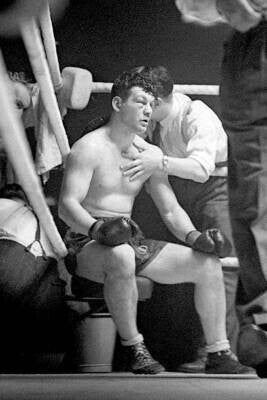
I researched with interest to find that Doncaster does have a seemingly (sadly) now forgotten cultural global sporting icon, our very own Bruce Woodcock who was a light-heavy-weight and heavy-weight boxer from Doncaster. Bruce held the British and Empire titles from 1945 to 1950, and was the European heavyweight champion 1946–1949. More impressively he finished his career with a record of 35 wins of which 31 were knockouts. This guy was boxing machine, in a time when boxing was a truly, truly brutal sport - I wish he was around now, I'd have loved to see him box.


Bruce Woodcock - A Friendly Face
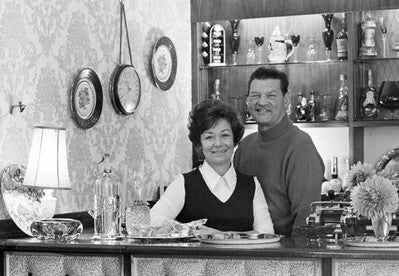
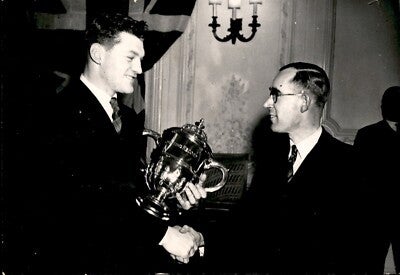
The funny thing is if you look at these images of Bruce training, socialising or working each photo has a style of the 1960s Kray Twins vibe mixed with Albert Finney's classic scenes in the film Saturday Night Sunday Morning, all very stylish, looking almost carefree during a time which was very tough. As a contrast and I'm not surprise to read, all anecdotes of Bruce from 'Donny' are all positive and that he was a true gentleman & a gentle giant. Looking at some forums around the internet, one local summed it up for me by saying' "An absolute gentleman who always had time to stop and talk whilst out walking his dog even though we were a rag tag group of kids". Here's a brief history of his career.
At the age of six, Bruce began boxing, and by the time he was twelve, he was a schoolboy champion. He later joined the LNER as a railway fitter and became a member of the amateur boxing club that was attached to his workplace at that time. From what I've read, Bruce also trained in a tiny, home-made gym in an old stable at the back of The Plough pub in Doncaster. Nevertheless, from such old-fashioned training facilities, Bruce launched a world-class career. The gym is also said to have served as a hideaway for none other than the notorious Dick Turpin himself in the 1730s!
His father, a former lightweight champion in the British Army, trained him in his early years. He qualified for the 1939 ABA finals at the Royal Albert Hall after winning the Northern Counties light heavyweight title in 1938–1939. He then competed for England at the 1939 European Amateur Boxing Championships in Dublin. Bruce then won the British and Empire heavyweight tiles in July 1945 at White Hart Lane in Tottenham, defeating the reigning champion Jack London. In the sixth round, Woodcock defeated London three times before winning via knockout.
Total fights: 39 Wins: 35 Win by: KO 31

Ranked Third In The World!
In 1945 Bruce was ranked third in the world by The Ring magazine. Bruce won the next four fights in a row, including a victory over the Irish champion Martin Thornton, before notching the first loss of his career with a TKO loss to the much more experienced Mauriello in May 1946 at the Madison Square Garden. Bruce immediately regained form by earning a points victory over Freddie Mills in June, before taking the European championship by knocking out Paul Albert Renet in the sixth round in July. Bruce continued to deliver results in the next three fights, knocking out Gus Lesnevich in September. The year finished with a bang as Bruce knocked out the French champion Georges Martin in November, with a stoppage over Nils Andersson in December.
In March 1947, Bruce successfully defended his European title against Stephane Olek, but a month later suffered his second loss, this time to Joe Baksi at the famous Harringay Arena in what was advertised as a final eliminator for the World title. He was knocked down three times in the opening round and twice more in the second round before attempting to make a dramatic comeback in the match before it was stopped by the referee in the seventh round.
In 1949, Bruce signed a training contract with entrepreneur Leslie Salts to train at Gwrych Castle in Abergele. During his time there, he would draw in over 200,000 spectators to a sparring session in one weekend of May 1950!
Bruce bounced back in remarkable style, winning bouts against Lee Oma and Lee Savold, and then knocked out Johnny Ralph in the third round in March 1949 to claim the British Empire Title (now Commonwealth Title) in South Africa.
On 2nd June 1949, he again won over Freddie Mills to retain the British, European, and Empire Heavyweight Championships via a KO in the 14th round in the presence of 50,000 spectators at the White City Stadium. As a part of his training in 1950, Bruce dangled a £100 prize for anyone sparring with him and succeeding in knocking him down, and a prize of £5 for anyone lasting a full round on their legs. Bruce followed this with a bout for the British version of the World Heavyweight Championship against Lee Savold on June 6, 1950, at White City in front of an assembled crowd of over 50,000 fans. This bout was under the aegis of the British Boxing Board of Control and EBU, valid in Europe and Commonwealth countries, but not in the USA. However, in the end, a 15-round bout, Bruce’s left eye had a terrible cut, and his nose and mouth were streaming with blood. This match was halted in the fourth round by the referee. Thirty million fans tuned in on the BBC Radio to listen to the match!


Retirement From Boxing, Bruce's Keen!

Bruce married Nora Speight, who was also from Doncaster, in December 1946. They had two children, a son named Bruce, and a daughter named Janet. Bruce had a brother named Billy who was also a boxer. Nora and Bruce began operating the Angel Hotel in 1952 based in Bolsover.
Later on, Bruce became a boxing manager. He was involved with local boxers such as Peter Aldridge and Peter Bates. Bruce also operated a pub called The Tumbler in Edlington (Doncaster). Bruce died on the 21st of December 1997 at the age of 77 years.
The British actor Brian Blessed, tried to make a movie about his boxing hero Bruce in 1971. He gathered support from other colleagues in Z-Cars, named as David Rose and Alan Plater, but could not move to production work as unfortunately Bruce showed no enthusiasm to be featured.
In 2013, a biographical book on Bruce written by Bryan Hughes called "Battling Bruce: The Story of the Fighting Career and Rise to Fame of Bruce Woodcock" was released. The same year, the author also began advocating for a statue depicting Bruce.
What an amazing character and great life Bruce had. Doncaster needs that statue!



Add comment
Comments